Plateau
A governed laboratory for exploring possible systems before they become commitments.
Plateau is Deep Bound Research’s design-space intelligence system. It explores candidate products, hardware forms, infrastructure systems, operational models, interface patterns, and runtime architectures by generating alternatives, mapping constraints, scoring feasibility, and preserving the strongest candidates as reviewable artifacts.
Concept boards are only one output. The deeper function is architectural search: converting ambiguous ideas into structured options that can be compared, governed, promoted, archived, or rejected.

Approved Categories
Design-Space Pipeline
Plateau turns ambiguous system ideas into governed design candidates. The pipeline explores alternatives, maps constraints, scores feasibility, and promotes selected candidates into product, research, or engineering tracks.
Explore
Generate candidate systems across multiple possible directions: product models, hardware forms, interface patterns, deployment surfaces, runtime architectures, and operational workflows.
Constrain
Map the relevant constraints: physics, materials, cost, safety, governance, UX, data, deployment, maintenance, public-safety, and operational scope.
Score
Evaluate candidates against feasibility, novelty, strategic value, implementation path, public disclosure safety, and fit with the lab's active systems.
Promote
Move strong candidates into the correct next surface: PRD, prototype, research note, system architecture, visual artifact, or internal backlog.
Archive
Preserve both accepted and rejected candidates as searchable design memory so future architecture decisions do not restart from zero.
What Plateau Produces
Plateau produces more than visual boards. It creates structured design intelligence that helps the lab decide what to build, what to test, what to publish, and what to archive.
Candidate Architectures
Structured options for products, platforms, machines, infrastructure systems, and AI runtimes before implementation begins.
Constraint Maps
Readable summaries of technical, operational, safety, cost, deployment, and governance constraints that shape a design space.
Feasibility Scores
Comparative scoring that helps decide whether a candidate should be promoted, revised, archived, or rejected.
Concept Boards
Visual artifacts that compress complex systems into reviewable form: orthographic layouts, system diagrams, interface studies, and deployment views.
Promotion Packets
Hand-off-ready packages that can become PRDs, prototypes, research notes, engineering specs, or public artifacts.
Design Memory
An archive of explored directions so the lab preserves not only what it builds, but what it considered and why.
Design Programs
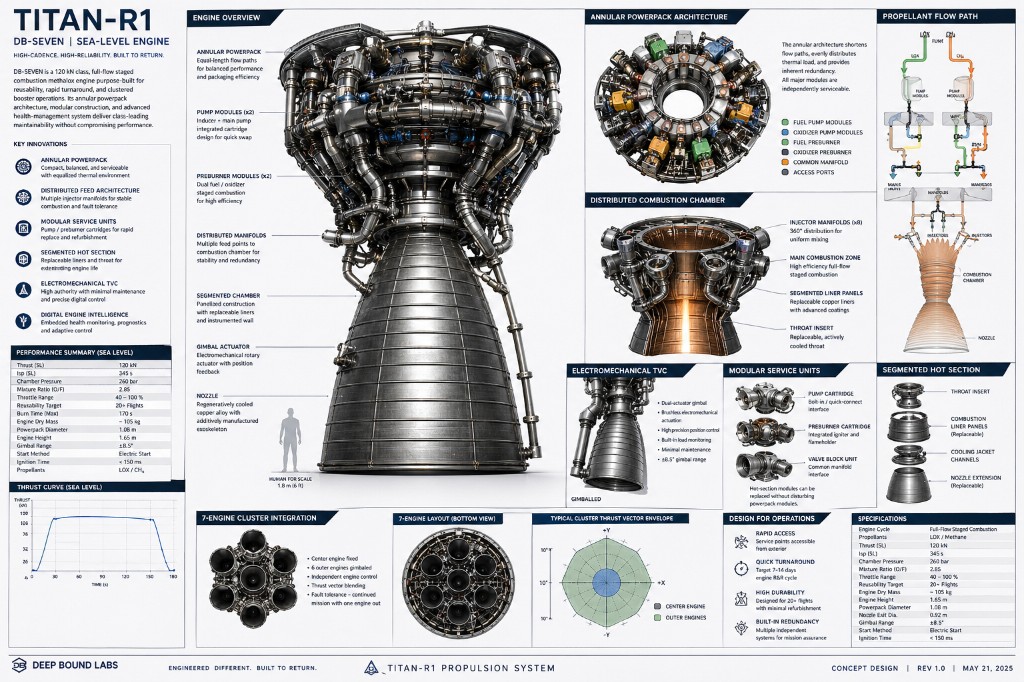
Full design-space programs explored through Plateau — each a governed multi-module concept study mapping constraints, interfaces, and feasibility across a complete system.
Berra Industries
Applied Autonomous Systems Division
Berra Industries is the autonomous systems and advanced hardware division emerging from Deep Bound Research Lab research under the Plateau initiative — focused on rugged, field-deployable unmanned systems for maritime operations, infrastructure inspection, emergency response, industrial monitoring, autonomous reconnaissance, and harsh-environment deployment.
Where Plateau focuses on advanced systems research, simulation environments, runtime architectures, and future operational frameworks, Berra Industries transforms those concepts into deployable physical systems.
Plateau explores future systems. Berra Industries operationalizes them.
Platform Domains
- Autonomous maritime vehicles
- Modular drone ecosystems
- Ground robotic systems
- Fleet telemetry systems
- Edge AI deployments
- Runtime autonomy stacks
- Sensor fusion systems
- Disaster response systems
- Infrastructure inspection platforms
Engineering Philosophy
- Field-first design
- Modular hardware
- Replaceable components
- Edge compute deployment
- Rugged environmental tolerance
- Operational autonomy
- Human-assisted control fallback
- Manufacturing feasibility
Full-Stack Autonomy
- Autonomous runtime systems
- Edge AI deployment
- Modular drone architectures
- Maritime autonomous vehicles
- Ground robotics
- Fleet telemetry
- Sensor fusion
- Swarm coordination
- Real-world deployment engineering
The objective is not speculative concept art or theoretical robotics, but deployable systems grounded in manufacturable engineering realities.
Featured Platform
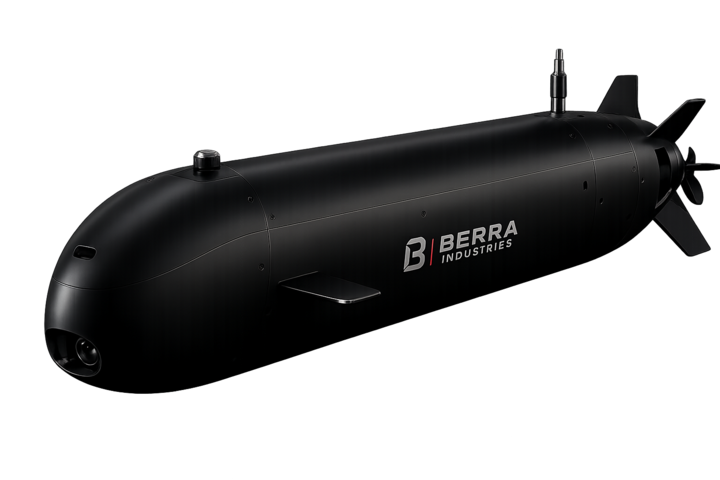
M1 Barracuda
Autonomous Maritime Reconnaissance Platform
The M1 Barracuda is a compact autonomous maritime vehicle developed for coastal, industrial, inspection, reconnaissance, and emergency-response operations. Designed around a low-profile hydrodynamic body, the platform emphasizes stability, long-duration operation, modular payload integration, rugged deployment, edge autonomy, and real-world maintainability.
Mission Profiles
- Port inspection
- Harbor monitoring
- Flood-zone assessment
- Environmental monitoring
- Coastal reconnaissance
- Infrastructure inspection
- Pipeline and dock surveying
- Emergency-response scouting
- Autonomous patrol operations
Core Architecture
- Modular sensor bay
- GPS + inertial navigation
- Edge AI inference module
- Computer vision pipeline
- Remote telemetry uplink
- Operator override support
- Swappable payload modules
- Multi-camera support
- Future swarm coordination capability
Runtime Layer — Badlands Runtime
The M1 Barracuda operates on the Badlands Runtime, a rugged autonomy framework designed for degraded environments and distributed unmanned operations.
- Edge decision systems
- Mission-state management
- Telemetry synchronization
- Fault-tolerant operation
- Navigation coordination
- Runtime health monitoring
- Sensor fusion orchestration
Design Philosophy
The M1 Barracuda is intentionally designed to avoid excessive complexity. Rather than building experimental showcase hardware, Berra Industries is focused on systems that can realistically transition from prototype to operational deployment.
Current Focus Systems
M1 Barracuda
Autonomous Maritime Platform
Badlands Runtime
Rugged autonomy runtime layer
Hive Fleet Architecture
Modular unmanned systems ecosystem
GX-Class Ground Platforms
Terrestrial autonomy platforms
Disaster-response drone systems
Emergency deployment
Infrastructure & industrial inspection systems
Field monitoring
Public Design-Space Archive
Public-safe artifacts from Plateau's design-space intelligence pipeline: candidate systems, architecture studies, interface explorations, hardware forms, infrastructure models, and visual evidence packages.
Plateau artifacts shown publicly are public-safe outputs from the design-space process, not a public product release. Plateau is an internal research system. Internal scoring logic, unreleased system concepts, and private design sessions are not disclosed.
Disclosure Framework
Plateau operates under a strict disclosure framework. Each concept board undergoes visibility review before publication. The framework governs what may be shown, what must be withheld, and how disclosed material is labeled.
Published — Public-Safe
- Civilian emergency response systems
- Industrial infrastructure concepts
- Orthographic form studies
- Runtime and interface visualization
- Systems architecture diagrams
Restricted — Not Published
- Offensive or weapons systems
- Targeting or targeting-adjacent concepts
- Confidential partner material
- Exploit-sensitive implementation detail
- Unreleased flagship system internals